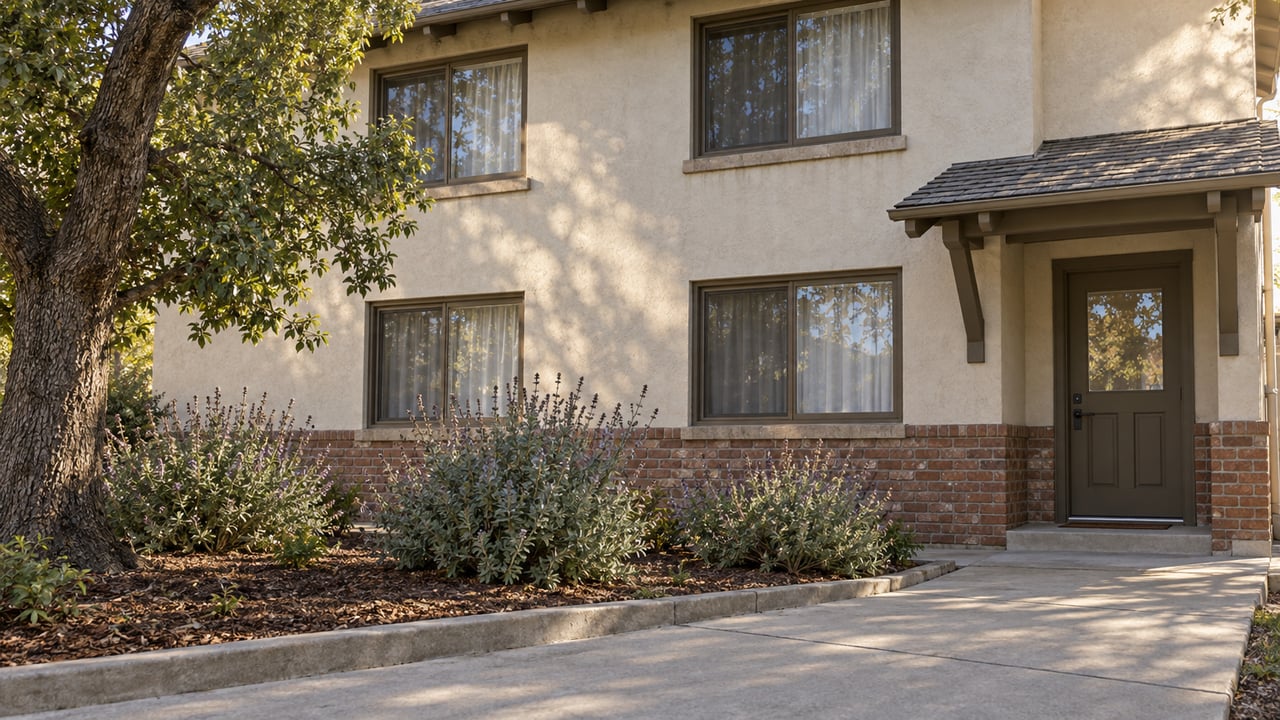
Petaluma's New Apartments Skip the Middle, and Older Rental Buildings Fill It
October 15, 2026
October 15, 2026
If a tenant in an older Petaluma two-bedroom gave notice tomorrow, which newly built apartment could they move into? For a household in the middle of the income range, the answer in fall 2026 is very few. That answer matters more to a buyer of a small apartment building here than any countywide rent average. It shapes what the tenants already in the building are likely to do, and in Petaluma, the tenants already in the building are what you are buying.
Petaluma's Residential Tenancy Protections, Chapter 6.60 of the Municipal Code, became permanent through Ordinance No. 2848 N.C.S., which was adopted May 15, 2023. For covered multifamily units, its just-cause rules apply from the first day of a tenancy. The statewide just-cause rule generally starts only after 12 months of continuous lawful occupancy.
The small-owner exemption is narrow. It covers owners who hold three or fewer rental units in the city, who are not a REIT, a corporation, or an LLC with a corporate member, and who have given tenants the required written notice. Someone buying a fourplex or larger is generally outside that exemption, subject to the ordinance's other exceptions.
When a covered tenancy ends for a no-fault reason, the ordinance requires relocation assistance equal to the lesser of 250% of one month's rent or $9,000. The $9,000 figure adjusts annually for inflation, and the payment is due within 14 calendar days of serving the notice.
Rent increases on in-place tenants are governed by the state Tenant Protection Act. The Attorney General's current table sets the maximum for Sonoma County at 8.6% for increases taking effect between August 1, 2026 and July 31, 2027. When a tenant moves out, the owner may set the new tenant's starting rent. Civil Code Section 1947.12 is scheduled to remain in effect until January 1, 2030.
Together, these rules mean an owner cannot easily force a rent reset. Resets happen when tenants leave by choice, so the rate of voluntary turnover depends on what else is available to them. That is the question the city's pipeline answers.
Here are the larger rental projects in local coverage, with their most recently reported status:
| Project | Address | Units | Affordability as reported | Status |
|---|---|---|---|---|
| Meridian at Petaluma North Station | 890 N. McDowell Blvd. | 131 | Targets 20–60% AMI per city listing | Under construction as of May 2026 |
| Rovina Lane Apartments | 2 Rovina Lane | 32 | 31 restricted from 30% to 80% AMI, plus a manager's unit | Under construction as of May 2026 |
| Washington Commons | 825 E. Washington St. | 49 | Extremely low and very low income | Building permits issued in 2025 |
| River Place Apartments | 1601 Petaluma Blvd. South | 50 | All-affordable | Built during 2025; opening date not confirmed |
| Sid Commons | 70 Jess Ave. | 180 | Not stated in coverage | Entitled in 2026, no building permits yet |
| Gallaher Senior Living | 1221 Petaluma Blvd. North | 85 | Not stated in coverage | Entitled in 2026, no building permits yet |
The city's own documents describe Meridian two ways. A 2021 approval letter gave a range of 30–80% AMI, while the later city listing and a 2023 city press release say the apartments target 20–60%. The December 2024 state tax credit staff report for Rovina Lane lists 9 units at 30% AMI, 3 at 50%, 4 at 60%, and 15 at 80%. In April 2025, the Argus-Courier reported that the council had approved $25 million in tax-exempt bonds for Rovina and that move-ins could begin as early as January 2027. Downtown, Eden Housing finished a rehabilitation of Downtown River Apartments at 35 E. Washington St. in September 2025. The work renovated its 81 existing apartments and added six more.
Citywide, Petaluma issued building permits in 2025 for 164 new rentals in larger structures, and Petaluma Voice reported that "the vast majority will be classified as very-low- or low-income."
The same May 2026 coverage of the city's 2025 Housing Element progress report shows the gap. Since 2022, Petaluma has permitted 648 of the 1,910 housing units in its current Housing Element target, about 34%. For moderate-income households, those earning 80% to 120% of area median income, it has permitted 35 of the 313 units it committed to by 2031. City spokesperson Jamieson Bunn explained why:
"Moderate-income housing is often the most difficult to produce because it typically doesn't qualify for the same subsidies as lower-income housing, while still facing high construction and land costs."
For a sense of who falls in that tier, Petaluma's FY2026 income chart puts the 80% AMI limit at $105,500 for a two-person household and $118,700 for three people. The 60% AMI limits for those households are $79,140 and $89,040. A two-person household earning $90,000 is above the income limit for a 60% AMI unit at Meridian, and new construction aimed at that household is scarce.
The state's 2026 rent limits for tax-credit housing show how close the "affordable" ceiling sits to ordinary market rent in Sonoma County. The table below sets the CTCAC maximum rents, effective May 1, 2026, next to HUD's FY2026 Fair Market Rents for the Santa Rosa–Petaluma metro area. HUD's FY2026 figures took effect October 1, 2025.
| Unit size | 30% AMI cap | 60% AMI cap | 80% AMI cap | HUD FMR, metro |
|---|---|---|---|---|
| Studio | $865 | $1,731 | $2,308 | $1,949 |
| 1 bedroom | $927 | $1,854 | $2,473 | $2,155 |
| 2 bedrooms | $1,113 | $2,226 | $2,968 | $2,827 |
| 3 bedrooms | $1,285 | $2,571 | $3,428 | $3,887 |
HUD sets Fair Market Rents at the 40th percentile of gross rents. They are benchmarks, not live asking rents. Even so, the pattern holds across the table. For studios through two-bedrooms, the 80% AMI ceiling is higher than HUD's metro benchmark. A restricted 80% AMI two-bedroom can legally rent for $2,968, while the 40th-percentile metro two-bedroom is $2,827. At the 60% tier, the two-bedroom cap is about $600 below the benchmark, and at 30% it is about $1,700 below.
Petaluma's ZIP-level benchmarks are higher than the metro figure. HUD's FY2026 Small Area FMR for a two-bedroom is $2,990 in 94952 and $3,430 in 94954. The Press Democrat used those figures in its July 30, 2026 analysis of the National Low Income Housing Coalition's "Out of Reach" report. That analysis found a full-time worker would need $57.50 an hour to afford the 94952 two-bedroom and $65.96 an hour in 94954, which runs from east Petaluma south to the Marin line. The paper notes that these estimates may not reflect current local rents.
So in Petaluma, an 80% AMI rent is about the same as a typical rent. The only new units that compete head-on with an older market-rate two-bedroom are the 80% AMI units. The research identified 15 of them at Rovina Lane. Most of the rest of the pipeline is priced and income-qualified for households below 60% AMI.
Taken together, the evidence points one way. The new subsidized supply is real and substantial, but most of it serves a different renter than the tenant in a 1970s fourplex off Petaluma Boulevard. The moderate-income household has few new options. The city's own report shows that tier lagging, and the city's spokesperson says subsidy programs don't reach it.
For an owner, that gap and Chapter 6.60 together shape the value of a building. Tenants with few alternatives tend to have little reason to move, and the ordinance gives them protection from the first day of their lease. In-place rents rise at no more than the state cap. Upside from turnover comes when a tenant chooses to leave, not on a schedule the owner sets. A pro forma that assumes several units reset to market each year is assuming a turnover rate that this local supply picture does little to produce.
This is an interpretation of the incentives, not a forecast. It still suggests some useful questions to ask during due diligence:
Does Petaluma have rent control on apartments? The research did not find a local rent-stabilization cap on apartments in Chapter 6.60. The ordinance covers terminations, relocation, and retaliation. Rent increases on covered units fall under the state Tenant Protection Act. A city attorney or a real estate attorney can confirm how these rules apply to a specific property.
Will Meridian and Rovina Lane pull tenants out of older buildings? They will draw some households, mainly those who qualify at the lower income tiers. Rovina Lane's 80% AMI units are the clearest overlap with market-rate two-bedrooms, because their rent ceiling sits near HUD's market benchmark.
Is the AB 1482 cap the same everywhere in the Bay Area? No. For increases starting between August 1, 2026 and July 31, 2027, the cap is 8.8% in Marin County and the other San Francisco-area counties, and 8.6% in Sonoma County.
If you are underwriting an older Petaluma building and want a second read on its rent roll, its tenant tenure, and how Chapter 6.60 shapes the upside, Mershad Rezayati can walk through the numbers with you, in English or Farsi. Get in Touch.
This article is general information, not legal, tax or financial advice. Consult a qualified professional about your situation.
Stay up to date on the latest real estate trends.

Why Marin County Continues to Attract Second Home Buyers
Is Marin County a Good Market for Fix and Flip Investing?


With integrity and a strong work ethic, we deliver a level of service at the forefront of today's real estate market. We offer the services of housing market experts, marketing specialists, and a home-closing real estate team, so your buying and selling experience is in clear view and at ease.