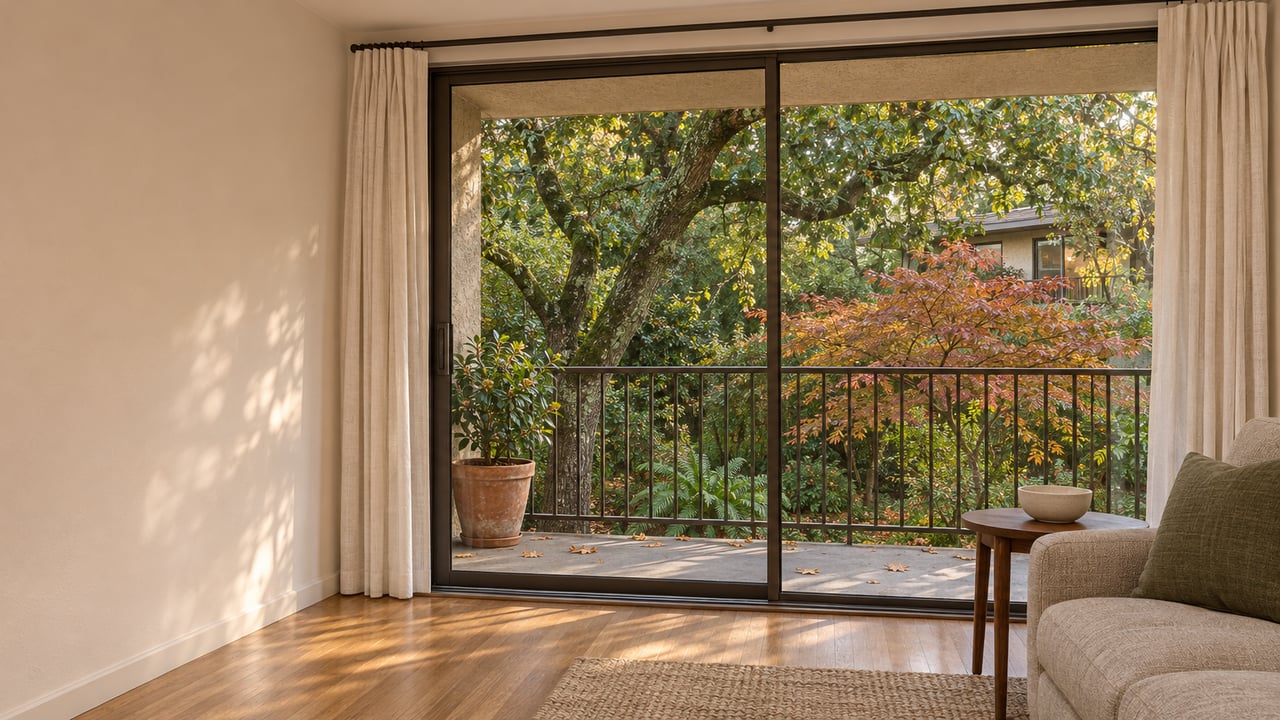
Larkspur's Rent Cap Now Binds Tighter Than California's. What That Means for an Older Apartment Building
November 12, 2026
November 12, 2026
Take two 1970s apartment buildings in Marin County, each renewing a $3,000-a-month lease this winter. If the first one falls only under state law, its owner can raise that rent by as much as 8.8%. If the second sits inside Larkspur city limits, its owner is limited to 7%. The buildings are about the same age and quality, and the counties are the same. On that one unit, the difference is $54 a month. In the building you are thinking of buying, it shows up in every renewal on the rent roll.
For most of the past few years, these two numbers didn't separate much. Today they do, and older Larkspur buildings are priced differently because of it. The local cap is the tighter number right now. It covers only part of the city's rental stock, it has a scheduled end date, and after the city's 2025 vote, there is no city database to confirm a seller's rent history. A buyer has to underwrite all three of these facts at once.
California's Tenant Protection Act, often called AB 1482, limits annual increases on most rental housing more than 15 years old to 5% plus the change in the cost of living, with a maximum of 10%. The California Attorney General's rent cap chart lists 8.8% for Marin County for increases that take effect between August 1, 2026 and July 31, 2027. The figure for the previous year was 6.3%.
Larkspur uses a similar formula with a lower ceiling. Under Chapter 6.20 of the Larkspur Municipal Code, the Larkspur Rent Stabilization Ordinance limits increases to 5% plus the San Francisco-Oakland-Hayward CPI or 7%, whichever is lower, and allows one increase in any 12-month period. The Attorney General's chart confirms that a local cap applies when it produces the smaller increase.
The math explains why this matters now. Larkspur's formula reaches its 7% ceiling once regional CPI goes above 2%. This year's state figure of 8.8% reflects a 3.8% cost-of-living change. As long as inflation stays near that level, the local cap is the binding limit on covered Larkspur units, and the state cap doesn't come into play.
| On a $3,000 monthly rent | State cap only, 8/1/26 to 7/31/27 | Larkspur local cap |
|---|---|---|
| Maximum annual increase | 8.8% | 7% |
| New monthly rent | $3,264 | $3,210 |
| Added annual income per unit | $3,168 | $2,520 |
That $648 gap per unit each year looks small. Across a 12-unit building it adds up to about $7,800 in yearly income. At a 5% cap rate, that is roughly $155,000 of value a buyer can't pay for. The gap also compounds with every renewal cycle while the cap stays in place.
Not every Larkspur rental is covered. State law exempts buildings with a certificate of occupancy issued after February 1, 1995 from local rent caps, and Larkspur's ordinance writes that exemption in directly. The ordinance also exempts deed-restricted affordable housing, owner-occupied duplexes in the same structure, ADUs and JADUs, and certain single-family homes and condos owned by individuals that have given the required written notice.
In practice, Larkspur has two groups of rental buildings that can look alike from the street. In a 1994 building, renewals are capped at 7%. A building finished in 1996 is subject only to the state's 8.8%, and only if it is more than 15 years old. A buyer comparing them on price per unit is comparing different income streams. Before the rent roll, the first document to pull is the certificate of occupancy.
Both groups share one feature. When a tenant moves out, state law lets the owner set the new tenant's starting rent. In a covered building, then, rent growth comes mostly from turnover. A building with long-term tenants paying well below market may stay that way for years. A pro forma that assumes those units reach market rent by renewal alone doesn't fit Larkspur's rules.
This is the friction that tends to show up mid-escrow. Larkspur's ordinance sets base rent as the rent in effect on May 8, 2023 for tenancies that started before then. For later tenancies, it's the initial rent charged at move-in. Every lawful rent after that is the base rent plus increases allowed under the chapter. An increase doesn't take effect if the owner failed to comply with the chapter, including its notice requirements, or failed to maintain the unit to state habitability standards. An owner who intentionally collects more than the lawful amount can be liable to the tenant for three times the overcharge, plus attorney fees.
The city did try to keep a record. A June 4, 2025 city staff report says the ordinance took effect April 4, 2024, after a March 2024 referendum failed to rescind it. Larkspur then spent about ten months building an online rental registry with 3Di Systems, launched it in March 2025, and received a letter from the California Apartment Association questioning the city's authority to require filings. The Marin Independent Journal reported that the council then voted 4 to 1 to drop the registry. Fewer than 10% of units had fully registered, and the system cost $200,000 to set up and $52,000 a year to maintain. Enforcement now relies on tenant complaints.
So no city record exists to check a seller's numbers against. If a past increase went above the cap or was issued without the required notice, the rent roll will still show the higher figure, and a buyer underwriting that roll is pricing income the ordinance may not support. In Larkspur, the increase notices issued since May 2023 belong in the due diligence request, and how any past increase measures against the chapter is a question for the buyer's attorney before the contingency period ends.
Larkspur's rent stabilization chapter automatically sunsets on January 1, 2030 under Ordinance 1073. The city's local just cause eviction and tenant protection chapter, Chapter 6.30, has the same sunset date under Ordinance 1075, adopted June 5, 2024.
For anyone underwriting a hold period, that changes the math. A buyer closing in early 2027 would face about three years of the 7% ceiling, then return to the state cap, as the code stands today. A council can amend an ordinance before it expires, so the sunset is an assumption to test, not a certainty. Voters have already weighed in on this policy. In November 2024, Larkspur's Measure K, an initiative to lower the cap, failed with 62.07% voting no, according to Local News Matters. The ordinance has now survived a referendum that would have repealed it and an initiative that would have tightened it.
The ordinance also includes a release valve. An owner who believes the cap prevents a fair return can file a fair return petition. The owner pays the city's review costs and must provide an independent financial report. The city manager weighs factors that include capital improvements, property tax changes and operating expenses, and either side can appeal to a five-member rent review board. The process exists, but it costs money and takes time, and it is no substitute for buying at a price that works under the cap.
Larkspur's largest recent apartment sale shows the rent-growth bet in its plainest form. Serenity at Larkspur is a 342-unit complex at 700 Lincoln Village Circle. It is now marketed as Finch at Larkspur. It was bought in 2019 with about $226.5 million in tax-exempt bonds issued by the California Community Housing Agency. After the bonds defaulted, the Marin Independent Journal reported that a sale of about $170 million to Pacific Multifamily Investors had closed by April 2026. That works out to about $497,000 per unit, down from about $662,000 in 2019.
At the time of the sale, the complex averaged $2,663 for a one-bedroom and $3,377 for a two-bedroom, with vacancy above 11%. Under its earlier bond structure, increases were limited to 4% a year. The project administrator told the paper that the market-rate buyer would aim to raise rents. The December 2025 IJ report noted that the complex's rents were already above the Marin averages that CoStar reported for the third quarter of 2025, $2,494 for a one-bedroom and $3,202 for a two-bedroom. It also noted that the property returns to the tax rolls after years in which local agencies gave up about $3 million a year.
The new owner takes on a property tax bill the previous owner didn't pay, starts with double-digit vacancy, and needs rent growth to make the numbers work. For a pre-1995 building, Chapter 6.20 limits that plan on every renewal, and in a covered building any upside above 7% comes from turnover.
New supply won't change this soon. The Ross Valley Sanitary District's 10.7-acre site at 2000 Larkspur Landing Circle is planned for at least 300 homes, with 25% affordable to households at or below 50% of area median income. When the Marin Independent Journal covered it in August 2025, the project was still at the developer-selection stage. New construction would fall outside the local cap in any case.
This post is general information, not legal, tax or financial advice. Before acting on any of these rules, confirm how they apply to a specific property with a qualified attorney or advisor.
If you're weighing an older Larkspur apartment building, the certificate of occupancy and the rent increase file are where underwriting begins. Mershad Rezayati can help you rebuild a rent roll against Chapter 6.20, model a hold period around the 2030 sunset, and decide what price the in-place income supports. Get in Touch.
Stay up to date on the latest real estate trends.

Why Marin County Continues to Attract Second Home Buyers
With integrity and a strong work ethic, we deliver a level of service at the forefront of today's real estate market. We offer the services of housing market experts, marketing specialists, and a home-closing real estate team, so your buying and selling experience is in clear view and at ease.